Guides · Saver Miles Team · November 3, 2026 · 10 min read
Hyatt's Deadline Is Real. Rushing Points Across Usually Isn't.
Bilt cuts Hyatt transfers to 4:3 on January 1. Everyone says move your points first. That advice ignores the chart Hyatt rewrote in May, which can take the saving straight back.
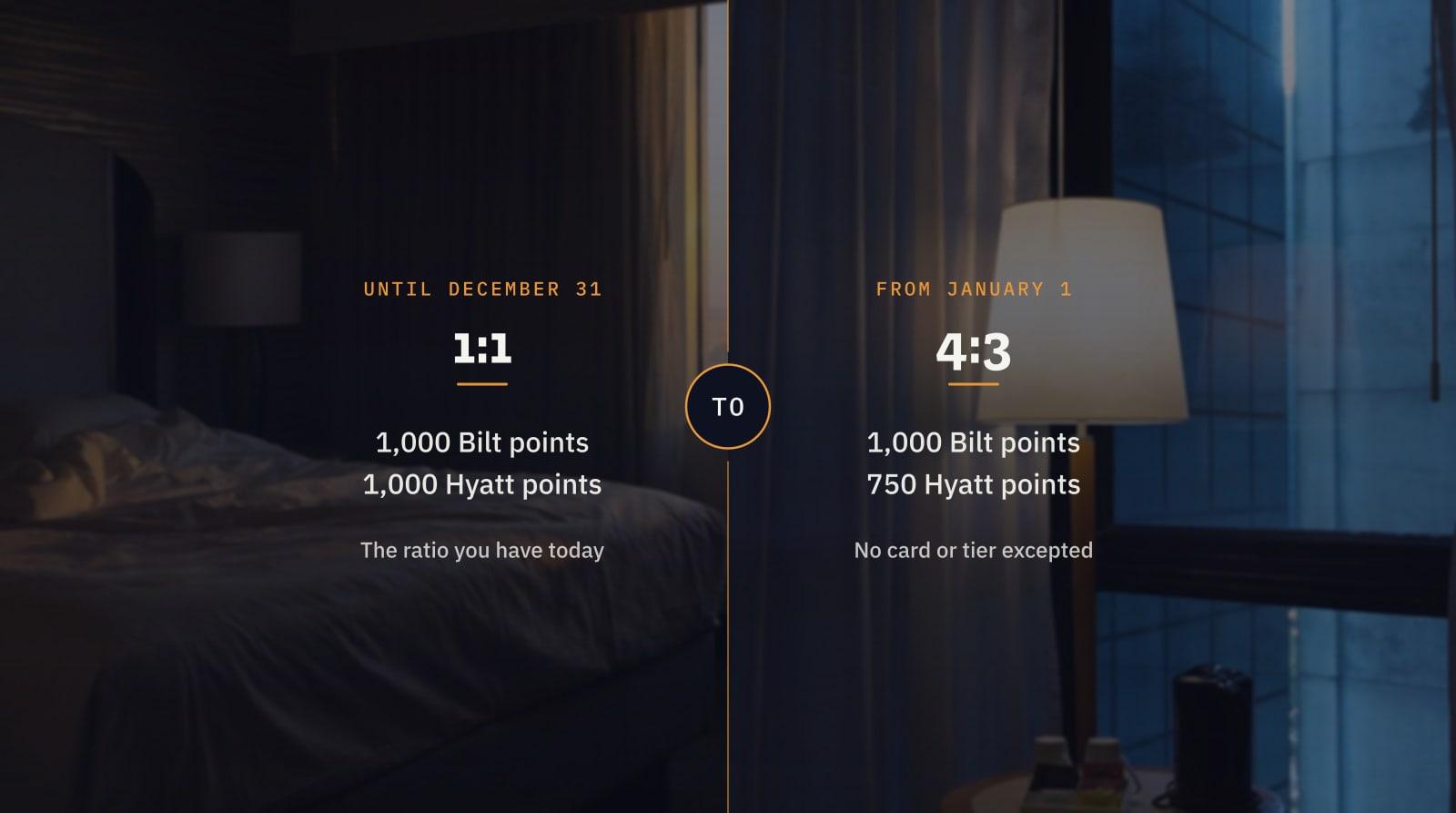
Bilt points transfer to World of Hyatt at 1:1 today and at 4:3 from January 1, 2027, and Chase already made the same cut on October 1. The advice everywhere is to move your points before the date. That is right only if you know which stay they are for, because Hyatt rebuilt its award chart in May and the top of it rose by two thirds.
Key takeaways
- Bilt's notice says the ratio changes to 4:3 beginning January 1, 2027, and carves out nothing: no card and no status tier is named as an exception.
- Chase cut to 4:3 on October 1, 2026 for the Ink Business Preferred, for Sapphire Preferred accounts opened before June 15, 2026, and for existing Ink Plus and Corporate Flex accounts.
- Chase kept 1:1 on its Reserve-branded accounts and says it has no planned changes to those at this time, which is a hedge rather than a promise.
- Hyatt replaced three redemption levels with five on May 20, 2026. The ceiling rose from 45,000 to 75,000 points a night, but the bottom fell, and early measurements put the typical rise nearer 10 to 12 percent.
Two different devaluations are happening to the same points, and most write-ups cover one of them.
The first is the transfer ratio, which has a date on it and is therefore easy to report. The second is what a Hyatt point buys once you own it, which has no single date and is much harder to write about. Put them together and the familiar advice, transfer before January 1, turns from obvious into conditional.
What actually changed
Chase, already in effect. Since October 1, 2026, Chase Ultimate Rewards transfer to World of Hyatt at 4:3 from the Ink Business Preferred, from Sapphire Preferred accounts opened before June 15, 2026, and from existing Ink Plus and Corporate Flex accounts. Chase's own wording is plain: transfer 1,000 Ultimate Rewards points and you receive 750 World of Hyatt points.
The June date matters for a specific group. Anyone approved for a Sapphire Preferred on or after June 15, 2026 got the lower rate from the day they were approved rather than on October 1.
Chase, still at 1:1. Reserve-branded accounts were not on the list: the Sapphire Reserve, the Sapphire Reserve for Business, and the invitation-only J.P. Morgan Reserve. Chase has said it has no planned changes to those at this time. Note the hedge, and note that this is established by what Chase did not say rather than by a published commitment.
One useful wrinkle: Ultimate Rewards can be pooled between your own Chase cards, so points earned on a Freedom or an Ink can be moved into a Reserve account and transferred from there at 1:1. The surviving door is a type of account, not a single card in your wallet.
Bilt, from January 1, 2027. Bilt's partner page carries a one-line notice that the ratio changes to 4:3 at the start of the year. It names no exceptions, for any card or any tier, and Bilt has not published anything further addressing scope.
So after January 1, an Ultimate Rewards balance sitting in a Reserve-branded account is the only transferable-points route into World of Hyatt still running at 1:1. There is one other way in, worth knowing but not a substitute: Air Canada Aeroplan converts to Hyatt at 2:1 for members with linked Aeroplan elite status, and Aeroplan itself is reachable from several card currencies. Half rate plus a status requirement is a fallback, not a plan.
The advice everyone is giving
Move your points before the date. It is not wrong. A 4:3 ratio really does cost 25 percent of every point you move after the deadline, and if you are certain you will use Hyatt points, transferring at 1:1 while you can is free money.
The trouble is the word certain, and the fact that a transfer cannot be undone. Our transfer partners guide sets out the rule the whole practice rests on: confirm what you are booking before you move anything, because points that land in the wrong program do not come back. A deadline does not suspend that rule. It just makes people feel it does.
The devaluation nobody puts next to it
On May 20, 2026, Hyatt replaced its three redemption levels with five inside each of its eight categories: Lowest, Low, Moderate, Upper and Top. The old Off-Peak, Standard and Peak labels are gone, so any advice still using them predates the change.
The chart itself switched over in a single morning. What Hyatt described as gradual was the migration into it: limited hotels moving a limited number of nights into the Upper and Top categories during 2026, with broader adoption in the years that follow.
That is the part that matters here. The structure is already in place and hotels are still moving into its expensive end. Transfer a large balance in December to beat the Bilt date and you are buying into a chart whose top is still filling up, without a booking to protect you.
Keep the size of that risk honest, because the headline figure is widely misread. The much-quoted two thirds increase is a ceiling: the most expensive category's top rate went from 45,000 points a night to 75,000. It is not what happened to a typical room, Hyatt never published it as a percentage, and it compares two differently named tiers. Meanwhile the cheapest category's floor went down, from 3,500 points to 3,000, and one survey of popular properties taken days after launch found average pricing up about 10 to 12 percent, with the top band applied sparingly.
Now the arithmetic, both directions. Take a night that sits at the new 75,000 ceiling. Before January 1 a Bilt member needs 75,000 Bilt points. After, at 4:3, they need 100,000. The deadline genuinely costs 25,000 points on that stay, and beating it is worth real money.
Run the other order, though. Move 100,000 Bilt points in December to beat the date, then watch the property you had in mind migrate into Upper or Top as the rollout continues. You now hold points that buy less than they did, in a currency that cannot be moved back, to avoid a 25 percent haircut you would only ever have paid on the points you actually spent.
When beating the deadline is clearly right
There is a narrow case, and it is worth taking when it applies:
- You have a specific stay in mind, at a property whose current award price you have looked up, on dates you can book now. Hyatt opens awards twelve months ahead for everyone, and thirteen for top-tier members and primary cardholders.
- You can book it immediately, not merely intend to.
- You are transferring only what that booking needs, not the whole balance.
One important limit on how much protection a booking buys. Awards ticketed before the May cutover kept their original points price even where the property moved up. But Hyatt is clear that an award booked or changed after the cutover follows the new chart, so modifying an existing reservation reprices it. A booking protects the price you hold while you hold it unchanged. It is not a shield you can keep rearranging.
When it is probably wrong
- You have no stay picked out. You are speculating on your own future behaviour in a program still moving hotels into its upper bands.
- Your travel is far out. The further away the stay, the more of that migration sits between you and the booking.
- You are moving the whole balance "to be safe". Safety here means keeping optionality, and the transferable balance is the optionality.
- You might not use Hyatt at all. A 25 percent haircut on points you spend beats a total loss on points you strand.
What the cards actually tell you to do
If you are a genuine Hyatt regular, a Reserve account keeps 1:1 and the sum is simple: work out how many Hyatt points you realistically move in a year, take a quarter of them, and compare that with the difference in annual fee between a Reserve and a Preferred. For most people it does not come close, and the honest answer is to accept 4:3 and spend the points well.
If you are a Bilt member there is no card to upgrade into and no status to chase. The date applies to everyone.
And if the conclusion is that Hyatt is no longer the automatic home for your points, that is a legitimate outcome. Points can also be spent as cash through a travel portal, usually the weaker option but not always, which we compared honestly in travel portal versus transfer partners.
Where a specialist comes in
Everything above is one decision with a date attached. The real version has more in it: which of your balances is affected, what each is worth in the programs you would actually use, whether the stay or the flight you want is bookable at a price you have verified, and whether moving now genuinely beats moving later for your trip rather than in the abstract.
That is the work we do by hand. A specialist looks at what you hold, checks what is really bookable, and says what to move and when, so points travel once, in the right direction, against something confirmed. How it works sets out the process and pricing shows what it costs. If points are new to you, the foundation guide covers the basics first.
Frequently asked questions
When exactly does the Bilt to Hyatt transfer change?
Bilt's partner page says the ratio changes to 4:3 beginning January 1, 2027, so 1,000 Bilt points will become 750 World of Hyatt points. Transfers made before that still go through at the current 1:1. The notice names no exceptions for any card or status tier, and Bilt has not published anything further on scope, so do not assume a premium card is carved out. Transfers are one way and cannot be reversed, which makes the date a reason to decide rather than a reason to rush.
Which accounts still transfer to Hyatt at 1:1?
Chase Ultimate Rewards sent from a Reserve-branded account: the Sapphire Reserve, the Sapphire Reserve for Business, or the invitation-only J.P. Morgan Reserve. Because Ultimate Rewards can be pooled between your own Chase cards, points earned on other Chase products can be moved into a Reserve account and transferred from there. Chase says it has no planned changes to those rates at this time. The only other way into Hyatt from a card currency runs through Air Canada Aeroplan at 2:1 and requires linked Aeroplan elite status, which is a fallback rather than a replacement.
Should I transfer all my points to Hyatt before the deadline?
Only the portion you can attach to a stay you have priced and can book now. Hyatt replaced three redemption levels with five in May 2026, lifting its ceiling from 45,000 to 75,000 points a night, and hotels are still migrating into those upper bands, so points moved early can lose value after they arrive. Transferring a whole balance to beat a ratio change trades a known 25 percent cost for an unknown one, in a currency that cannot be moved back.
Are Hyatt points still worth more than other hotel points?
Hyatt remains the highest valued of the major hotel currencies and every outlet that publishes valuations agrees on that ranking, even though they disagree on the number, which currently sits somewhere between roughly 1.4 and 1.8 cents depending on who is measuring. They also disagree about the May chart change: one major valuation found Hyatt's median unchanged because few properties were affected, while another concluded it had fallen to the lowest figure that outlet had ever published for the program. Treat the ranking as settled and the precise number as contested.
Start your search
If you are holding Chase or Bilt points and staring at a date on the calendar, the useful question is not whether to beat it but what you would actually book. Start your search: tell us what you hold and where you want to go, and a specialist will tell you what is worth moving, what is worth keeping, and what it costs either way.
Related posts
Guides
Alaska Became Atmos. The Name Was the Smallest Change.
Nov 4, 202612 min

Guides
How to Find Last-Minute Premium Class Award Flights (Real Case: Vilnius to Miami in 3 Days)
Oct 1, 20265 min

Guides
Travel Portal vs. Transfer Partners: How to Choose
Sep 18, 202610 min

Guides
Phantom Award Space: Why "Available" Seats Vanish
Aug 31, 202610 min