Guides · Saver Miles Team · September 18, 2026 · 10 min read
Travel Portal vs. Transfer Partners: How to Choose
Your card's travel portal is simple. Transferring points to an airline can be worth far more. Here is the two-minute math that tells you which one this trip needs.
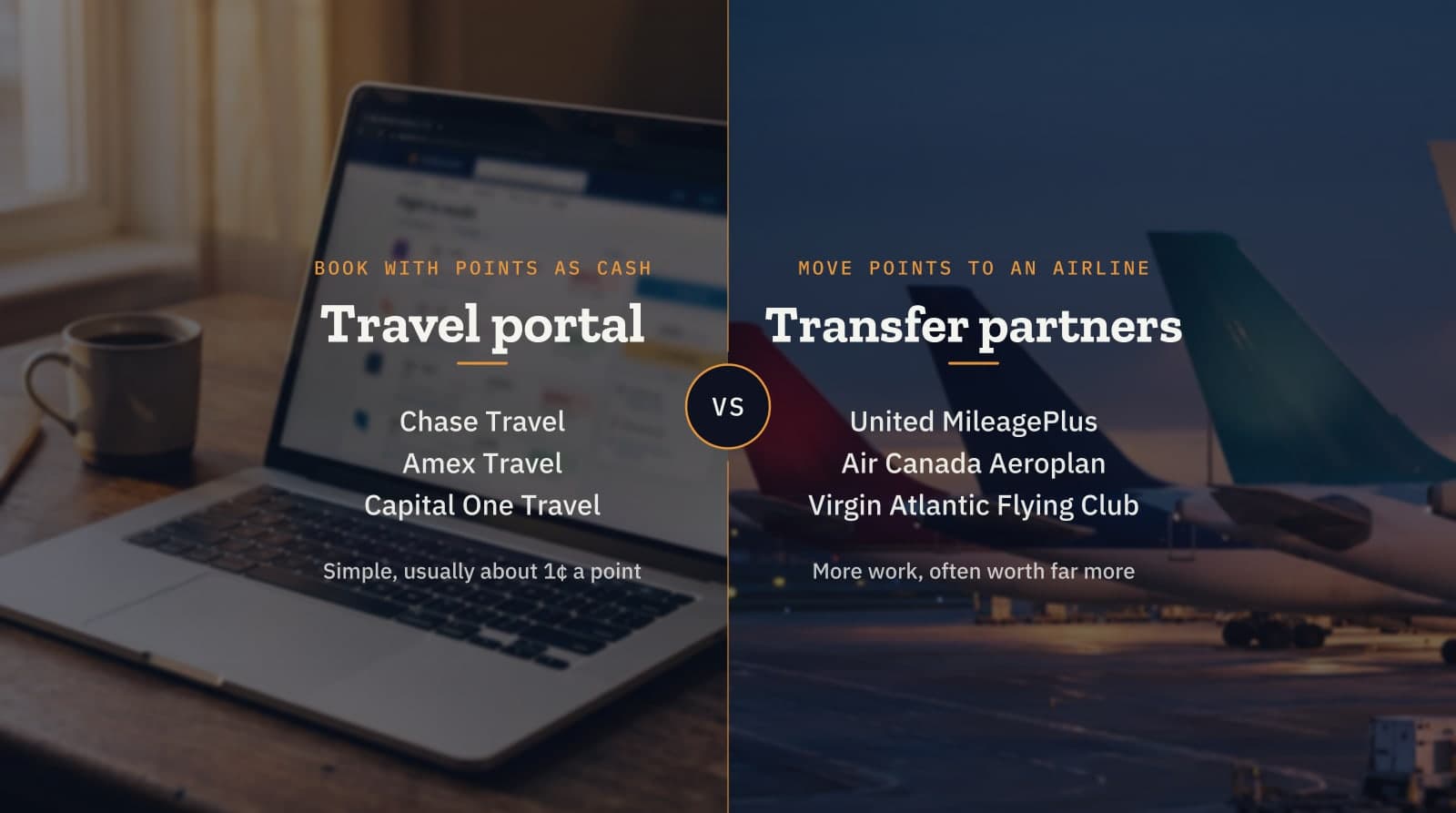
Book through your card's travel portal when the cash fare is low or no award seat exists; transfer to an airline partner when a premium seat prices far below its cash fare. To choose between a travel portal and transfer partners, work out the cents per point each path gives you after cash fees, then take the higher one. It takes about two minutes.
Key takeaways
- A portal booking is a paid ticket bought with points, so it needs no award space and usually earns airline miles like any cash fare.
- Transferring points buys an award seat, and its value swings widely: often poor on cheap flights, often several cents per point on long-haul premium cabins.
- Compare both paths in cents per point after cash fees, including any carrier-imposed surcharges on the award.
- Never transfer points before the award seat is confirmed, because transfers are one-way.
Every major transferable points card gives you two ways to fly. You can spend points inside the bank's own travel portal, where they buy an ordinary ticket at a set rate. Or you can move them to an airline program and book an award seat, where the same points can be worth a little or a lot.
Most advice picks a side. Portal fans like the simplicity; points enthusiasts say you should always transfer. Both are right some of the time, which is why the useful question isn't "which is better" but "which is better for this flight." The answer depends on a number you can calculate before you move anything.
What a portal booking actually buys you
A portal booking is a cash ticket that you pay for with points. Chase Travel, American Express Travel, Capital One Travel and Citi Travel all work this way: you search flights the way you would on any booking site, and at checkout your points cover the fare at the rate your card sets.
That one fact explains most of the tradeoffs.
It works like a paid ticket
Because the airline sees a paid fare, you don't need award space. If a fare is for sale in the portal, you can buy it with points, on any date the airline flies. Taxes are part of the price, so there's no separate cash bill at the end. And because it's a revenue ticket, you can usually add your frequent flyer number and earn airline miles for the trip, just as you would with a cash fare. American Express says so directly for flights booked with points through Amex Travel. Elite credit depends on the airline and the fare you pick, and at the time of writing, basic economy fares on American, Delta and United earn no miles for most travelers.
It is serviced by the portal, not the airline
The flip side: the portal is your travel agency for that ticket. Changes and cancellations usually go through the portal's service team rather than the airline's own desk (when the airline cancels a flight, it can often rebook you itself), and a refund the airline issues passes through the portal first, which can take longer. For a simple round trip that rarely matters. For a complicated itinerary, or a trip where plans might shift, it's worth knowing before you book.
What your points are worth in each card's portal
Portal rates are set by each issuer and change from time to time, so treat these as a snapshot at the time of writing and check the value your own account shows before you book:
- Chase Travel: points redeem at 1 cent each by default. With Points Boost, select rotating flights and hotels are worth up to 2 cents per point for Sapphire Reserve cardmembers and up to 1.5 cents for Sapphire Preferred. Reserve cardmembers who applied before June 23, 2025 can redeem points earned before October 26, 2025 at 1.5 cents on Chase Travel until October 26, 2027. Sapphire Preferred cardmembers who applied before that date get the same window at 1.25 cents.
- American Express Travel: Membership Rewards points cover flights at 1 cent each, with a 5,000-point minimum redemption.
- Capital One Travel: miles typically cover travel purchases at 1 cent each.
- Citi Travel: ThankYou points typically redeem for flights at 1 cent each.
- Bilt Travel: points are commonly reported at 1.25 cents each if you hold a Bilt card and 1 cent if you don't, so check the rate shown in your account.
The pattern matters more than the exact figures. Outside a boosted offer or a legacy rate, most portals turn a point into about a penny. That's a floor, not a ceiling, and it's the number every transfer has to beat.
The two-minute math: travel portal vs. transfer partners
The comparison comes down to one formula, applied to both paths for the same flight:
Cents per point = (cash price of the ticket minus cash you still pay) divided by points spent.
For the portal, the answer is simply the rate your card pays: usually 1 cent, or up to 1.5 or 2 cents on a boosted offer. For an award, you do the arithmetic. Here are two illustrative examples. They are round numbers chosen to show the method, not current fares or award prices.
A short domestic flight. Say an economy ticket costs $180 in cash. Through a portal at 1 cent per point, it costs 18,000 points. As an award, suppose the same flight prices at 12,500 miles plus $6 in taxes. That award works out to ($180 minus $6) divided by 12,500, or about 1.4 cents per point. The award edges out the base portal rate, but a 1.5-cent boosted offer would beat it. In points, the award saves about 5,500 over the base portal rate, while a boosted portal fare would cost about 12,000 and win outright. The portal ticket may also earn airline miles that the award won't, though not on a basic economy fare with American, Delta or United.
A long-haul business class seat. Now say a one-way business class ticket costs $5,000 in cash. Through a portal at 1 cent, that's 500,000 points; even at a 2-cent boost, it's 250,000. As an award, suppose it prices at 70,000 points plus $200 in fees. That's ($5,000 minus $200) divided by 70,000, or roughly 6.9 cents per point. Even if a program added $900 in carrier-imposed surcharges, the award would still land above 5 cents. Here the transfer wins by a wide margin.
Two cautions keep the math honest. First, count the cash side of the award properly: some programs add carrier-imposed surcharges that can shrink the gap a lot. Second, compare against a real, bookable award, not one a search tool displays. You can run your own balances through our points value calculator, and the same method is worked through in the valuation math in our guide to flying on credit card points.
When the portal wins
The portal is usually the right call in these situations:
- Cheap flights. On low domestic and short-haul economy fares, award prices are often close to or worse than a penny per point, so the portal's fixed rate holds up.
- No saver space. If no award seat exists on your dates, or only an expensive dynamically priced one, the portal can still sell you almost any seat the airline has for sale.
- Airlines you can't reach by transferring. If the airline you need isn't bookable through any of your card's partners, the portal may be the only way to use points on it.
- You want the miles and status. A portal ticket earns like a paid fare, which matters if you're chasing elite status with one airline.
- A boosted offer on your exact flight. When Chase shows a Points Boost offer on the flight you actually want, 1.5 or 2 cents per point with no award hunting is a solid result for an economy or short-haul trip.
Using the portal isn't a failure. On the right trip, it's the most efficient thing your points can do.
When transferring wins
Transferring points usually wins in these cases:
- Long-haul premium cabins. Business and first class seats carry high cash prices, while saver awards on the same flights are priced far lower in points. This is where values well above 2 cents per point tend to show up.
- Partner sweet spots. The same seat can be booked through several programs at very different prices, as the business class to Tokyo example shows. Knowing how transfer partners work is what opens those doors.
- Peak dates with award space. When cash fares spike around holidays but a saver award is still available, the award's value rises with the cash price.
Whatever the case, the golden rule doesn't change: find and confirm the award seat before you move a single point. Transfers into airline programs are one-way, and a seat that appears in a search can turn out to be phantom award space that won't ticket. Confirm, then transfer, then book.
Where a specialist comes in
The formula is simple. Getting accurate inputs is the work. For one flight, you need the cash fare, the portal's rate for your specific card, whether a boosted offer applies, which programs can see saver space on your dates, what each one charges in miles and surcharges, and whether your card's transfer ratio and timing will get the points there before the seat moves.
That's what a Saver Miles specialist does by hand. We price both paths for your exact flight, check real award availability across programs rather than cached search results, and tell you which way to book and why. When the portal is the better deal, we say so, and you keep your points flexible for a trip where a transfer earns its keep. You can see how it works step by step.
Frequently asked questions
Is it better to transfer points to an airline or book through the portal?
Neither is better every time. Transferring usually gives far more value on long-haul premium cabins, while the portal often wins on cheap economy fares, on dates with no award space, and on airlines your card can't reach through a partner. Compare the cents per point on both paths for the specific flight, after cash fees, and take the higher one.
Do you earn airline miles when booking through Chase Travel?
Generally yes, for flights. A flight booked through Chase Travel is a paid ticket, so you can add your frequent flyer number and usually earn miles, and depending on the airline and fare, elite credit, as you would with any cash fare. At the time of writing, basic economy fares on American, Delta and United earn no miles for most travelers, so check the fare type before you book.
Is Chase Points Boost worth it?
It can be. Points Boost raises the value of Chase points on select, rotating flights and hotels in Chase Travel, up to 2 cents per point for Sapphire Reserve and up to 1.5 cents for Sapphire Preferred at the time of writing. That's a strong result for economy and short-haul trips, but long-haul business class awards booked through a transfer partner often beat it, so compare before you book.
What is a good cents per point redemption?
Many points travelers treat about 1 cent per point as the floor, because that's what most bank travel portals pay without any effort. Anything meaningfully above that is a good redemption, and long-haul premium cabin awards are where values of several cents per point tend to appear. The right benchmark is always the best alternative use of the same points.
Start with a free points audit
If you're holding transferable points and a trip in mind, a specialist can run both paths for you. Start with a free points audit: tell us what you hold and where you want to go, and we'll tell you whether the portal or a transfer gets you there for less, before a single point moves.
Related posts

Guides
Phantom Award Space: Why "Available" Seats Vanish
Aug 31, 202610 min

Guides
A Human vs. the Award-Search Tools: What They Can't Do
Aug 31, 202610 min

Guides
Transfer Partners, Demystified: Points Into Miles
Aug 31, 202610 min

Guides
Fuel Surcharges: The Hidden Cost of Your "Free" Flight
Aug 31, 202610 min