Guides · Saver Miles Team · November 4, 2026 · 12 min read
Alaska Became Atmos. The Name Was the Smallest Change.
The rebrand got the coverage. The earning choice lands January 1, Bank of America is due in 2027, and the quieter repricing already happened while everyone was reading about the name.
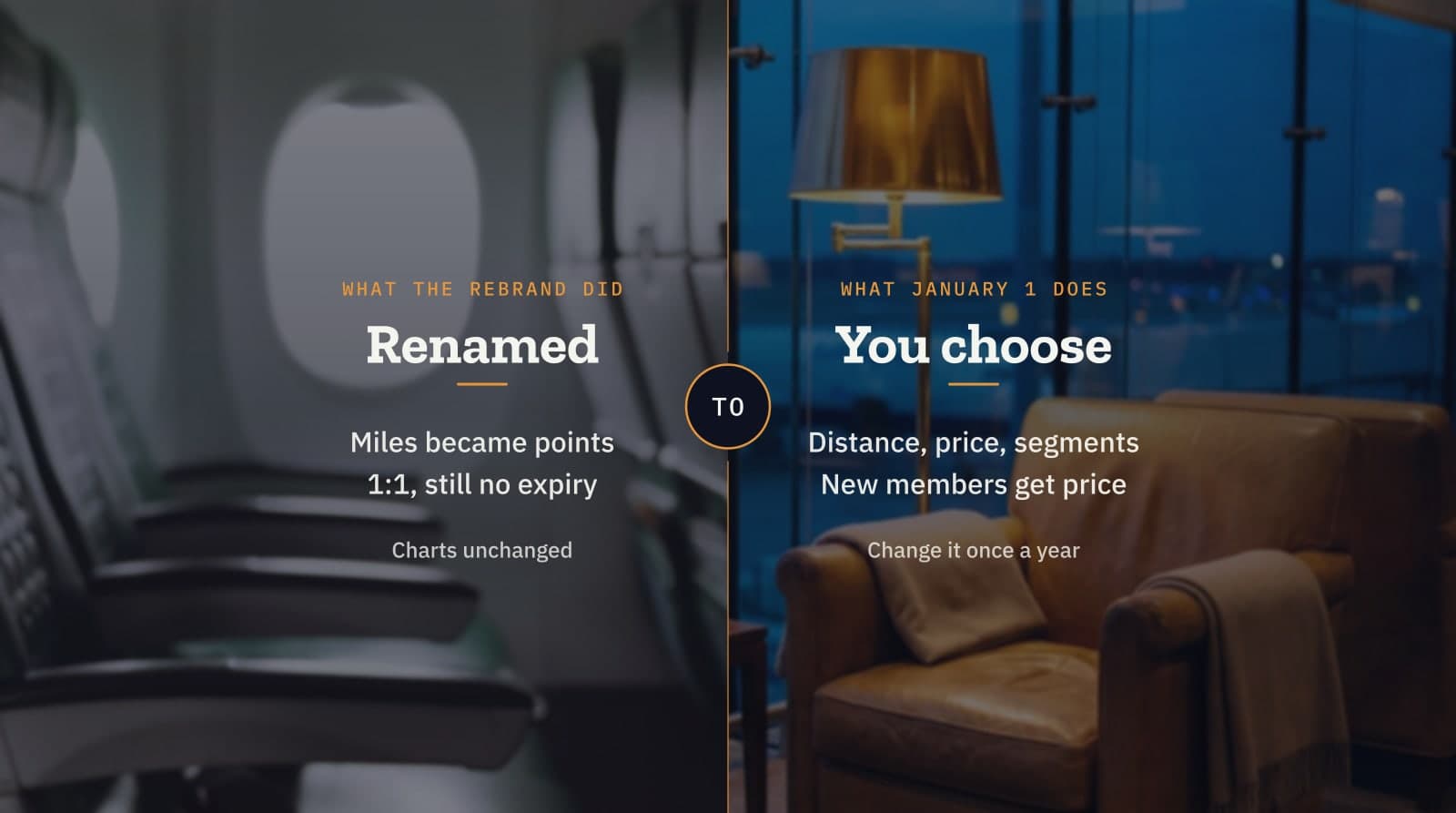
Alaska Mileage Plan and HawaiianMiles became Atmos Rewards, and miles became points at one for one. The two developments worth your attention are later and larger: from January 1, 2027 members choose how they earn points, with different defaults for existing and new members, and during 2027 Bank of America cardholders are due to gain the ability to transfer in.
Key takeaways
- The conversion itself was clean: one Mileage Plan or HawaiianMiles mile became one Atmos point, and points still do not expire.
- The repricing came later and separately. The own-metal award chart was reworked in October 2025, the partner award fee rose to $20 per person each way in July 2026, and cheap economy fares stopped earning in August 2026.
- From January 1, 2027, members choose to earn by distance traveled, price paid or segments flown, and can change that choice once per calendar year.
- The defaults differ, and distance is not a free pass. Existing members stay on distance unless they act, new members from January 1 default to price paid, and the 250% partner rate on business class fares continues only for those who choose price paid.
- Alaska says that during 2027 eligible Bank of America cardholders will be able to transfer points into Atmos, which would give that issuer a transferable-points route for the first time.
Most of the coverage treated this as a renaming exercise, which it was for about a week. The substance arrived afterwards: two announcements about how you earn, and a quieter run of changes that did move what awards cost.
What the rebrand actually did
Alaska launched Atmos Rewards on August 20, 2025, combining Mileage Plan and Hawaiian's HawaiianMiles. Miles became "points" and elite-qualifying miles became "status points".
It ran in two stages: Mileage Plan members converted immediately and kept their account numbers, while HawaiianMiles balances moved over on October 1, 2025, with a new number for anyone who had not linked their accounts. One mile became one point either way.
Worth being precise about one line that gets repeated. Alaska said at the transition that the value of points did not change, and that was true of the conversion itself. It was not a promise about the future, and the program has repriced since. Treat it as a statement about August 2025, not a standing guarantee.
What did carry across is the machinery that made the program worth holding: three partner award charts by region, each priced in distance bands, plus a separate chart for Alaska and Hawaiian flights, and membership of oneworld, which Hawaiian joined on April 23, 2026. Those charts are still the reason award travelers pay attention. Points themselves still have no expiration date, a policy from October 2022 that carried across unchanged, though an account dormant for 24 months can be locked until you call.
The repricing nobody covered
The rename was cosmetic. The year around it was not, and these are the changes that actually reached people booking awards.
The Alaska and Hawaiian chart was rebuilt in October 2025. The regional rows, Hawaii and Mexico, Central America and the Caribbean, were folded into pure distance bands for the airlines' own metal. Short Hawaii routes and inter-island awards got cheaper, and so did West Coast first class, down from a flat 40,000 to 30,000. Beyond 3,500 miles, which is most of the East Coast, that same flat 40,000 became 60,000. Own-metal awards now also move with demand, so those chart numbers are floors rather than prices. The partner charts get called the fixed ones, but Alaska's own terms make every published figure a starting rate too, which matters below.
The partner award booking fee went up 60%. From July 1, 2026 it is $20 per person each way, up from $12.50, and nonrefundable. On a family of four round-trip that is $160 before taxes.
Cheap economy stopped earning. Saver fares booked from June 11, 2026 and flown from August 1, 2026 earn no points and no status points at all, down from 30% of distance, though they still count toward Million Miler.
And partner awards have been pricing above chart since March 2026. Travelers found connecting partner itineraries quoted far above the published band, Europe and Asia roughly doubling. Alaska told three outlets it was a technical issue affecting some partner connections, since resolved, with no changes to the charts. That is where the story stops being tidy: readers of those outlets reported the same behaviour weeks later, and in mid-October 2026 a reader described a nonstop New York to Dublin business award quoted at 175,000 points against the 45,000 chart price, though their own explanation was withheld inventory rather than broken pricing. Either the fix is partial, or pricing above the published figure is what Alaska's starting-rate language always allowed. Anyone telling you the charts hold without qualification has not checked.
The choice arriving on January 1
This is the genuinely unusual part. From January 1, 2027, Atmos members select how they earn points and status points on flights:
- Distance traveled, the model Alaska has been known for and one of the last of its kind among large US programs. Note that it becomes a flat one point per mile: the class-of-service multipliers that premium fares earn today, which run from 125% up to 200% against a 100% economy base, do not survive into the distance option.
- Price paid, the revenue-based model most of the industry moved to years ago.
- Segments flown, a flat award per segment, which rewards frequency rather than distance or spend.
Offering the choice at all is a real differentiator. Cheap tickets across oceans want distance, expensive short hops want price, many short segments want segments. Historically a program picked one and you lived with it.
The choice also governs more than Alaska's own flights: it covers partner flights booked through Alaska or Hawaiian, and American Airlines flights however they were booked.
One catch undercuts the generosity, and sharply. Alaska raised partner earning on business class fares to 250% of distance flown, across all its partners, for flights booked through Alaska or Hawaiian. That increase is already live; Alaska's own partner pages describe it in the present tense. What changes on January 1 is who keeps it. Alaska's partner conditions say that members earning by distance will earn on actual distance flown, while the percentage ladder continues for those who have chosen price paid. So the distance option, the one existing members keep by doing nothing, drops to a flat one point per mile on partner flights. A premium-fare flyer who stays on distance loses the class-of-service multipliers and the 250% they are earning today. Inaction is not holding your position here; it is a cut.
The defaults are the part to read twice
A choice is only as good as what happens when nobody makes it, and here the defaults diverge.
Existing members who do nothing continue earning by distance, which protects the balances built under the old model, if not the partner rates above.
New members joining on or after January 1, 2027 default to price paid.
That second default is the quiet shift. Distance-based earning has been one of the clearest reasons to credit flights to Alaska rather than elsewhere, and new members will arrive on the revenue-based model unless they go and change it. The program stops handing its most distinctive feature to newcomers automatically.
If you join, or you have family joining, make the selection deliberately rather than inheriting it.
The Bank of America bridge
The second announcement matters more to points holders than anything above. Alaska says that during 2027 it plans to let customers with eligible Bank of America card products transfer points into Atmos Rewards, and to add arrangements with other financial institutions over time.
Bank of America's own travel currency has competed on cash-back-style redemptions at roughly a cent toward travel, while Chase, American Express, Capital One and Citi built the transferable-points ecosystem that makes premium-cabin award travel work. One precision, since it trips people up: Bank of America has issued the Alaska and Atmos co-branded cards for years, and those earn Atmos points directly. What it does not have today is an airline or hotel transfer partner for its own bank points. A route into Atmos would change that, through a program with a genuinely strong partner chart.
Two cautions. The ratio has not been announced, and ratio is everything: a partner at 1:0.7 is a very different proposition from one at 1:1, as we showed when working through whether a transfer bonus is worth taking. And "during 2027" is not a date; Alaska's wording is that it plans to. Treat it as a direction of travel, not something to choose a credit card over today.
Meanwhile the existing ways in are wider than usually reported: Bilt Rewards at one for one, Marriott Bonvoy at three to one, IHG One Rewards and Choice Privileges at five to one, and Diners Club Club Rewards at one for one. The hotel ratios are poor enough to be a way to use up an orphaned balance rather than a strategy, and slow: the IHG route starts with a phone call and can take six weeks, which rescues no seat you found today. Watch the direction too. Atmos transfers out to several hotel programs on better terms, a benefit only Summit cardholders can use, and those outbound ratios get quoted as if they were inbound.
What this means for a redeemer
No deadline is bearing down on you, so there is nothing to panic-transfer. But the honest version is not "nothing changed."
If you redeem on Alaska or Hawaiian metal, the October 2025 chart is your reality now. If you redeem on partners, budget the $20 fee per person each way and price the itinerary before you transfer anything, because the above-chart partner quotes have not been convincingly put to bed. If you earn on cheap fares, you have been earning nothing on them since August.
What changes next is where to credit flights, and potentially which cards are worth holding in 2027. Both are earning decisions. Neither requires you to move points now, and moving points into any airline program before you have a confirmed booking remains the mistake it has always been, as the transfer partners guide sets out. That applies especially to a program quoting partner prices its own chart does not explain.
Alaska's partner charts are still the reason to care, including for routes to Asia where its pricing has historically undercut the operating carrier's own program, though availability rather than price is the binding constraint there now. Our guide to business class to Tokyo with points covers that comparison, so confirm the live price on the day.
Where a specialist comes in
Earning choices and issuer partnerships are the kind of change that looks small and compounds. Picking the wrong earning model for how you actually fly costs you quietly, every trip, for a year. Holding the wrong cards for the programs you actually redeem in does the same thing more slowly.
That is the sort of question a specialist is useful for, alongside the booking itself. A real person looks at how you fly and what you hold, then tells you which program your flights belong in and which balances can genuinely reach the seat you want. How it works describes the process and pricing sets out what it costs. If this is new, start with the foundation guide.
Frequently asked questions
Did my Alaska miles change value when they became Atmos points?
The conversion was one for one. One Mileage Plan mile and one HawaiianMiles mile each became one Atmos Rewards point, Mileage Plan members kept their account numbers, and Alaska said at the time that the value of points did not change. Read that as a statement about the transition rather than a standing guarantee: the program has repriced since, including its own award chart and what discounted fares earn.
What changes on January 1, 2027?
Members choose how they earn points and status points on flights: by distance traveled, by price paid, or by segments flown. The selection opened on October 1, 2026 for flights departing on or after January 1, 2027, and can be changed once per calendar year. Existing members who make no selection continue earning by distance, while members who join on or after January 1, 2027 default to earning by price paid. The choice also applies to partner flights booked through Alaska or Hawaiian, and from that date the percentage-based partner earning rates, including 250% on business class fares, continue only for members who have chosen price paid.
Will Bank of America points transfer to Atmos Rewards?
Alaska has said it plans to enable transfers into Atmos Rewards from eligible Bank of America card products during 2027, and to add similar arrangements with other financial institutions over time. The ratio, the eligible cards and the timing have not been published. Treat it as a stated intention rather than a feature, and do not pick a credit card today on the strength of it.
Did Atmos award prices go up?
Some did, and one question is still open. The Alaska and Hawaiian own-metal chart was rebuilt in early October 2025: short Hawaii routes and inter-island awards got cheaper, and Hawaii first class fell from a flat 40,000 to 30,000 from the West Coast while rising to 60,000 beyond 3,500 miles. The partner award booking fee rose to $20 per person each way on July 1, 2026. The published partner charts themselves have not been revised, though Alaska's terms describe every figure on them as a starting rate, but since March 2026 travelers have repeatedly reported connecting partner itineraries quoted well above the chart price. Alaska described that as a resolved technical issue; reports of the same behaviour have continued since. Price your specific itinerary before you transfer points into the program.
Start your search
If you fly enough for the January earning choice to matter, or you are wondering which of your balances can actually book the trip you have in mind, that is worth working out properly. Start your search: tell us how you fly and what you hold, and a specialist will tell you where your flights belong and what your points can really book.
Related posts
Guides
Hyatt's Deadline Is Real. Rushing Points Across Usually Isn't.
Nov 3, 202610 min

Guides
How to Find Last-Minute Premium Class Award Flights (Real Case: Vilnius to Miami in 3 Days)
Oct 1, 20265 min

Guides
Travel Portal vs. Transfer Partners: How to Choose
Sep 18, 202610 min

Guides
Phantom Award Space: Why "Available" Seats Vanish
Aug 31, 202610 min